
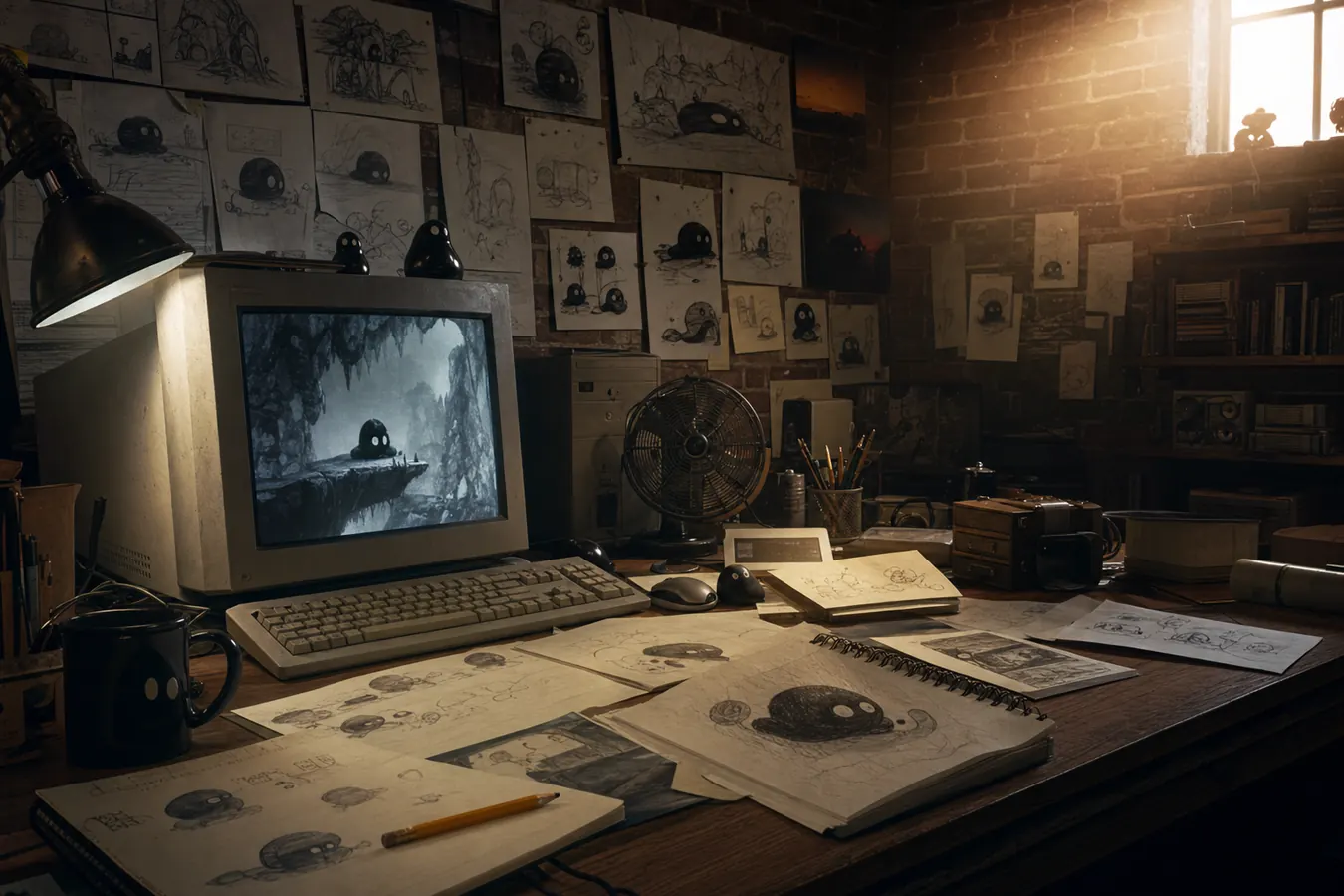
Gish began inside Chronic Logic, founded in 2001 in Santa Cruz. The team already had Triptych, a physics-heavy puzzle game. Artist and designer Edmund McMillen wanted a new concept that could reuse that simulation DNA. He pitched a living ball of tar. Lead programmer Alex Austin thought the idea sounded foolish—until prototypes proved the soft-body character was the fun.
Prototypes that shed an arm
Early designs gave Gish an arm to swing on, goo projectiles, and other gadgets. Many of those ideas died in testing. The keepers were stickiness, slickness, solidity, and a jump built from compression and expansion. Austin later wrote that laziness about sprite animation pushed him toward a fully physical avatar. That “shortcut” became the game’s identity.
Development split into two halves. The first tackled collision detection and soft-body stability. Austin wrote code in MS-DOS Editor and compiled with Visual C++. The second half covered levels, polish, and a level editor. McMillen built characters in Photoshop and Flash—originally dozens of enemies, later cut down to sixteen under schedule pressure. Self-imposed crunch was a real cost, as Austin admitted in the 2004 postmortem.
The guiding principle was simple: make it fun the way Super Mario Bros. and Pitfall! felt fun. Physics would supply the modern twist. Music and sound came from Tim Smolens and Jeff Attridge of Game Audio Magic, with Estradasphere-linked remix energy in the soundtrack.
Release, awards, and a studio that dissolved
Microsoft Windows shipped on May 4, 2004. Linux and Mac OS X followed on August 2, 2004. Reviews were generally favorable. In March 2005, the Independent Games Festival awarded Gish the Seumas McNally Grand Prize and Innovation in Game Design. Computer Games Magazine named it Best Independent Game for 2004.
Chronic Logic disbanded soon after launch. That breakup cost potential publishing deals. McMillen later joined Austin at Cryptic Sea. Cryptic Sea released a more universal Mac build in December 2007. Reflexive Entertainment began distributing the game through Reflexive Arcade in 2006, widening discovery for players who lived on download portals.
Meanwhile, mobile partners prepared a feature-phone edition. Hardwire and Erphenic Studios built Gish Mobile for J2ME, with Pixalon Studios and GlobalFun handling publishing and distribution. That lineage is covered on the Java page and connects later to the Android Reloaded era.
The sequel that waited in the pipes
By November 2007, Cryptic Sea had spent a couple of months on Gish 2. McMillen pitched the sequel to Microsoft in 2008 before shifting energy toward what became Super Meat Boy. Late in 2008, Gish 2 was formally put on hold so the studio could focus on No Quarter. Fans never got the full sequel—but the design lessons about precision platforming and character identity clearly traveled forward.
Open source, Humble Bundle, anniversary
In May 2010, Austin released the Gish source under GNU GPL-2.0-or-later. The same month, the game appeared in the first Humble Indie Bundle, introducing the tar blob to a new generation paying what they wanted. It returned in the Humble Voxatron Debut in November 2011.
Community forks such as FreeGish kept the engine running on newer systems. In January 2020, Austin and McMillen marked fifteen years with quality-of-life updates. Newgrounds user Tarhead created anniversary cover art. The project that started as a “dumb” pitch had become a living archive of early indie craft.
If you want to feel why the awards happened, move from this timeline into the gameplay guide. The history explains the studio; the abilities explain the joy. For platform availability questions after the PC era, see iOS, Android, and Java.
Gish’s story is also a reminder that indie success can be fragile. A Grand Prize does not guarantee a sequel, a lasting studio, or permanent mobile storefronts. What endured was the design idea: give the player a body that is also a puzzle tool, then fill the sewers with problems only that body can solve.
Money, myth, and the long tail
Austin later noted that revenue from Gish kept him afloat for several years. That detail matters more than trophy photos. In the mid-2000s, “indie” often meant betting rent on a weird idea. The Grand Prize money and ongoing sales turned a risky experiment into a livelihood, which in turn funded more prototypes at Cryptic Sea.
Myth-making around the IGF night—especially McMillen’s proposal—sometimes overshadows the craft. The real achievement is quieter: a collision system players trust enough to experiment. When sticky fails, they try slick. When slick fails, they go solid. That loop is the biography of the design, written in player behavior rather than press quotes.
The long tail includes Humble Bundle discovery, open-source forks, and anniversary patches. Each revival introduces people who never owned a 2004 Windows box. Some arrive from Meat Boy fandom. Some arrive from physics sandbox curiosity. This site exists so those newcomers get a factual spine: who built it, when it shipped, what happened to the sequel, and why mobile editions are a separate, careful conversation.
Read the homepage overview if you want the short map. Stay here when you want the studio chronology. Either path should leave you with respect for how much invention fit inside eight months and one blob of tar.
Chronic Logic is gone. Cryptic Sea’s chapter moved on. Gish remains—playable, patchable, and still strange enough to feel new when you first cling to a ceiling and wonder why nobody else thought of this sooner.