
Sticky
Climb walls, cling to ceilings, and plant yourself on objects you need to drag or swing.
Indie physics classic
A twelve-pound ball of tar, a kidnapped girlfriend, and a sewer city that only physics can conquer.
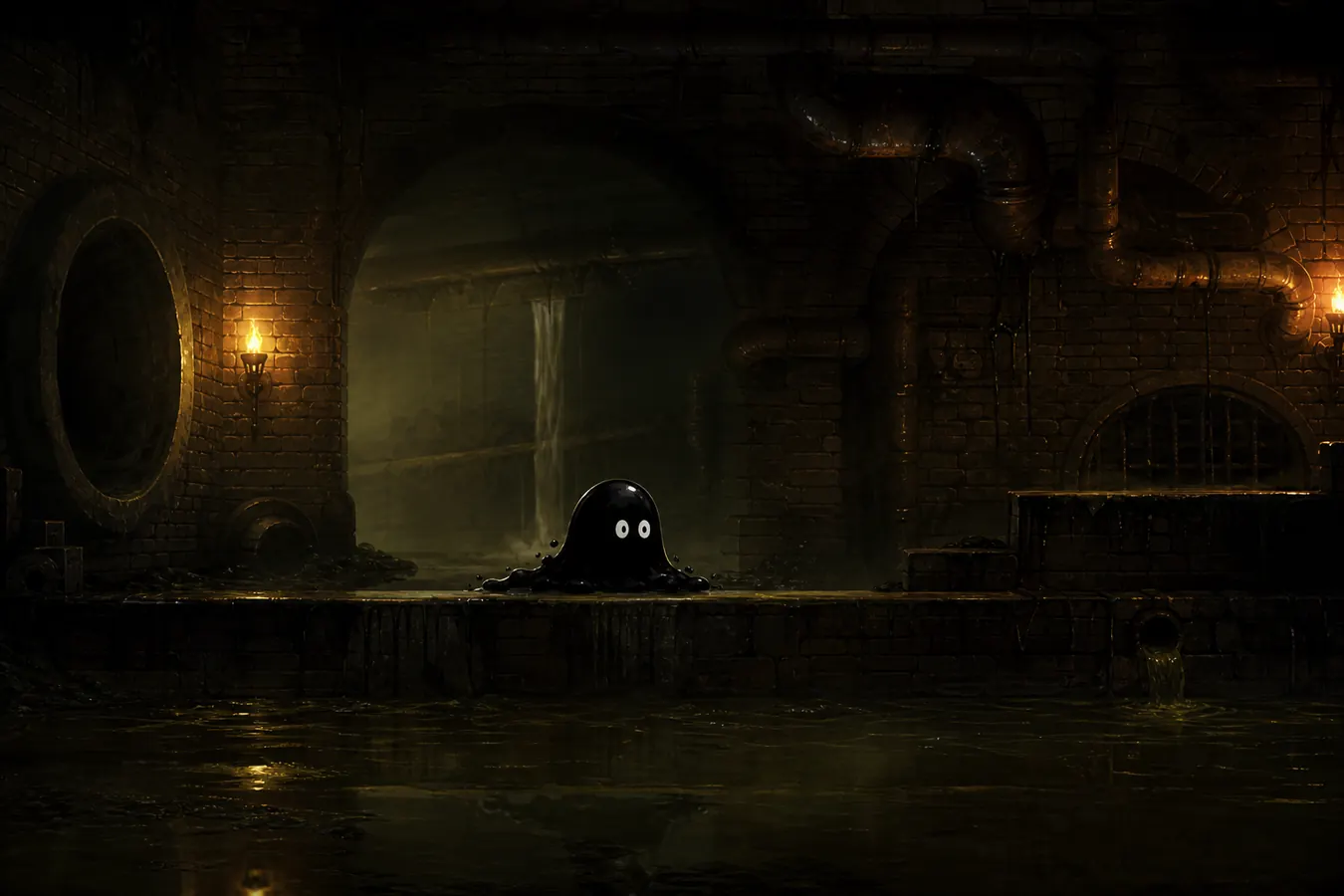
Gish is a 2004 physics-based platformer developed and published by Chronic Logic, an indie studio in Santa Cruz, California. You control a living ball of tar who must chase his human girlfriend, Brea, after a shadowy figure drags her into the sewers of Dross.
The game is not a standard jump-and-run. Every step, bounce, and wall cling is driven by a soft-body physics model. Gish can become sticky, slick, or solid, and he jumps by compressing and expanding rather than tapping a single hop button. That mix of puzzle solving and slapstick momentum made the title a landmark for independent PC games.
This site is a fan information guide. It explains the story behind the project, how the abilities work, and how mobile versions for Java phones, Android, and the iOS era fit into the larger timeline. It does not sell the game or host installers.
If you arrived here after hearing about McMillen’s later hits, start with the premise: Gish is older, gooier, and more experimental. The comedy is dryer. The controls ask for patience. The reward is a kind of physical literacy—once you understand how tar behaves, rooms that looked cruel start to look fair.
New players should budget time for the jump alone. Veterans revisiting after the 2020 anniversary update will find quality-of-life improvements on PC, while the core fantasy remains intact. Either way, treat this homepage as a map of tunnels rather than a storefront checkout.
At the 2005 Independent Games Festival, Gish won both the Seumas McNally Grand Prize and the award for Innovation in Game Design. Those wins put a tiny self-funded team on a global stage and helped prove that physics toys could carry a full adventure.
Art and design came from Edmund McMillen, later known for titles such as Super Meat Boy and The Binding of Isaac. Programming and systems work came from Alex Austin and Josiah Pisciotta. The writing credit belongs to Dave Strock, with music and sound from Game Audio Magic, including remixes tied to Tim Smolens’s band Estradasphere.
The game’s humor is dry and a little cruel. Endings can swing from a quirky happy escape to a bleak joke about lava awareness. That tone sits beside carefully tuned level design inspired by classic side-scrollers such as Super Mario Bros. and Pitfall!, updated with modern collision and mass.
For many players, Gish was a first taste of what “indie” meant before the word was everywhere: a strange premise, a tight scope, and a personality that no publisher committee would invent. Revenue from the game also kept Austin afloat for years after release, according to later interviews.
Gish’s body is the toolkit. Learn the states on the gameplay page, then mix them when a puzzle refuses to play fair.
Climb walls, cling to ceilings, and plant yourself on objects you need to drag or swing.
Drop friction. Slide through pipes, escape crushing spaces, and slip under obstacles.
Gain rigid mass to smash platforms, squash foes, sink in water, and push heavy props.
Compress, then expand to launch. Rhythm and timing replace a simple arcade leap.
Want icon-level detail and combination examples? Open the full gameplay guide.
Steam’s description captures the setup cleanly: a quiet walk with Brea ends when a figure pulls her into an open manhole. Gish follows her calls into a forgotten subterranean city packed with traps, demented creatures, and long corridors that punish careless momentum.
The antagonist turns out to be Hera, a former classmate with unrequited feelings. After the confrontation, Gish still has to save Brea. Succeed, and the pair escape into an absurdly bright future as entomologists with the world’s first legal inter-species marriage. Fail, and the game’s darker joke ending takes over.
That story is short on the page and long in the levels. The real narrative is how you reshape your body to answer each room. Wooden beams, ropes, water, and breakable floors all respond to mass and friction. Enemies are obstacles and punchlines at once, drawn in McMillen’s unmistakable cartoon style.
Story mode is the main campaign. Collection mode reframes exploration as a timed challenge. Vs. mode lets two players batter each other as rival blobs. Together, those modes keep the physics toy feeling fresh after the credits.
The studio looks for a new use of Triptych’s physics. McMillen pitches a tar blob. Austin prototypes a soft-body character after resisting the idea. Eight months of work produce a full PC release.
Gish takes the Grand Prize and Innovation award. McMillen famously uses part of the moment to propose to his girlfriend Danielle.
Reflexive Arcade carries the PC game. Cryptic Sea continues Mac support. A J2ME mobile edition from Hardwire, Erphenic, Pixalon, and GlobalFun targets feature phones.
Austin releases the source under GPL. Gish joins the first Humble Indie Bundle, then returns in the Humble Voxatron Debut. Community forks keep the physics alive.
HandyGames ships Android versions around 2010–2011. Those listings later disappear from Google Play. See the Android page for the honest status.
Austin and McMillen ship quality-of-life improvements. Newgrounds artist Tarhead creates anniversary cover art. The blob still drips.
Gish began on Windows, then reached Mac and Linux. Mobile adaptations followed in the late 2000s and early 2010s. Availability today varies by platform, and this guide stays honest about what is current versus archival.
How Gish Reloaded reached phones, why Play Store listings vanished, and where PC players should look now.
Android detailsWhy there is no confirmed modern App Store release of the original game, and what that means for iPhone players.
iOS detailsThe feature-phone port that brought the IGF winner to Nokia-era handsets through Pixalon and GlobalFun.
Java detailsIf you want the fullest experience, start on PC. Digital storefronts such as Steam have carried Gish for years, and the open-source release means community builds and forks exist for modern systems. Expect a learning curve: jumping alone takes practice before the first boss fight feels fair.
Play with patience. Treat sticky and slick as verbs, not toggles you forget. When a room looks impossible, ask which state changes the friction or mass. Many “combat” encounters are really physics jokes waiting for the right slam or slide.
Mobile pages on this site are historical and practical context, not promises of a current store download. If an official listing is gone, we say so. For Android and Java heritage, start with those dedicated guides. For iPhone, read the iOS page before chasing dead App Store links.
Gish Game welcomes players who like odd heroes, people researching McMillen’s early career, and anyone curious why a ball of tar won the IGF Grand Prize. It also helps collectors sorting out which mobile edition was J2ME, which was Android Reloaded, and which rumors never shipped.
You will not find piracy links, cracked JARs, or fake “tap to install” buttons. You will find researched summaries drawn from the IGF record, the Gamasutra postmortem by Alex Austin, contemporary mobile press, and long-running PC releases.
When you are ready to go deeper, open the gameplay breakdown for ability combinations, then the history essay for studio context and the canceled sequel path that led toward Super Meat Boy instead of Gish 2.
Life is not easy when you are a ball of tar. It is a lot more interesting once you understand how that tar thinks.
Gish proves that a memorable protagonist does not need limbs, dialogue trees, or a triple-A budget. It needs a verb set players can feel. Sticky, slick, and solid are easy to name and hard to master. That gap between concept and execution is where the game earns its reputation.
Level designers use the environment as a second character. Water cares about density. Wood cares about impact. Ropes care about attachment points. Enemies are often less about hit points and more about whether you arrive heavy, slippery, or clinging to the ceiling above them. The result is comedy with consequences.
Modern indie physics games still echo this structure. Whether or not a designer cites Gish by name, the pattern is familiar: one strange body, a handful of state changes, and rooms that punish autopilot. If you are studying game design, play a few Story stages slowly and write down which ability the room is secretly about. Then visit our gameplay page to compare notes.
The canceled Gish 2 also belongs in the lesson plan. Ambition without focus can stall a sequel, while a new project—Super Meat Boy—can carry forward the obsession with precise platform feel. History is not only what shipped. It is also what redirected the people who made it. Our history guide covers that fork in the road.
Facts on this site are cross-checked against public records: the Independent Games Festival award listings, Alex Austin’s Indie Postmortem for Chronic Logic’s Gish, contemporary coverage of the Humble Indie Bundle and open-source release, Steam’s long-running product page, and mobile press from the Pixalon / GlobalFun and HandyGames eras. Where storefronts disappear, we say so instead of inventing a download.
Illustrative heroes and icons on these pages are atmosphere art created for gishgame.com. They are not official screenshots and should not be treated as copyrighted game assets republished wholesale. Brand names remain the property of their owners. This is a fan information guide, not a publisher homepage.
If you notice a conflict between memory and documentation—especially around mobile SKUs—prefer primary announcements and catalog trackers over viral posts. Android Reloaded, Java Mobile, and iOS rumors are easy to blend together online. We keep them on separate pages so each claim can stand or fall on its own evidence.
Thanks for reading with care. The blob appreciates precision. Bookmark the platform pages if you research mobile games for a living, and send new players straight to gameplay so they learn why jumping feels like a science experiment. That is how a fan guide earns its keep: fewer myths, more usable tunnels under Dross.
Gish is excellent classroom material for talking about soft-body simulation, independent production, and tone in games. Show a sticky climb, then a slick escape, then a solid slam. Students see systems thinking without a lecture slide. Streamers get slapstick deaths that still feel earned. Just credit the creators and avoid presenting abandoned mobile builds as current downloads.
If your audience asks where to buy, point them to legitimate PC storefronts and this site’s platform honesty pages. That keeps entertainment aligned with the same facts we use in the archive. The blob deserves a clean introduction, not a scavenger hunt through broken store links.